Curriculum was at the heart of most Tide~ projects. What was the key – conformity or creativity?
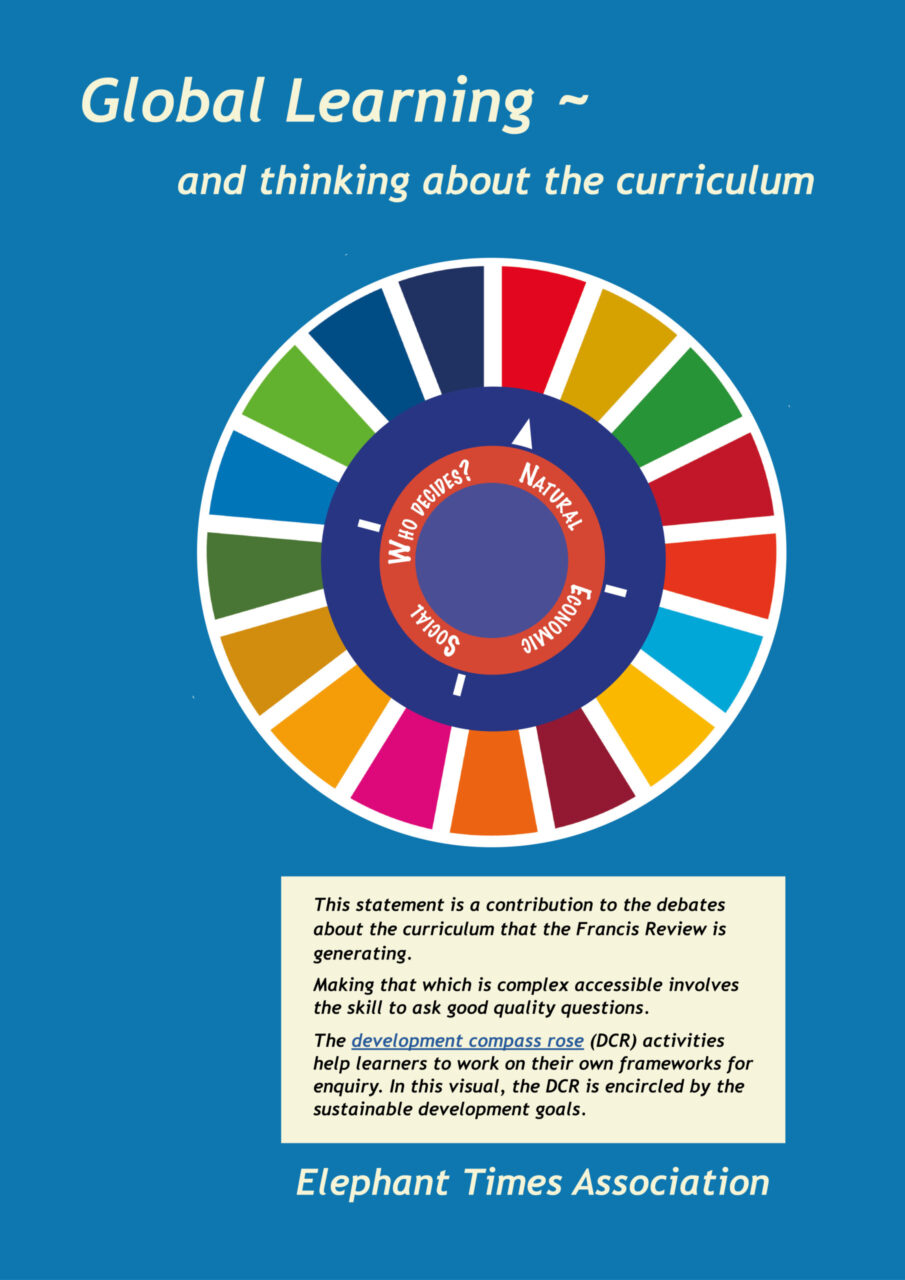
In this age of inter-connectedness, division, complexity, and uncertainty the need for global learning is increasingly important. We came to understand that global learning is as much about how people teach and learn, as about what they teach and learn. Global learning is an approach not a subject.
The paper: 'Global Learning and thinking about the curriculum' sums up that approach. It was written as a contribution to the Francis Curriculum Review [2024-25]
Making that which is complex accessible involves the skill to ask good quality questions. The development compass rose (DCR) became a feature of Tide~ work. The DCR activities enable learners to work on their own frameworks for enquiry.
"Global learning is not about new subjects, or new timetabled content. Instead, we worked collaboratively with teachers, and through them, their students, to develop projects about all aspects of the life of a school: the so-called 'hidden curriculum', the subjects taught, and extra-curricular activities: because all offer opportunities to develop children and young people's skills, dispositions, knowledge and understanding for effective participation in today's inter-connected and complex world."
Responding to curriculum change became an on-going opportunity / frustration? A few examples .....
An ITE tutor talked about enabling his students to develop skills to respond to yet another 'new curriculum'. People talk as if curriculum did not exist before the National Curriculum but as its best it was stronger with greater emphasis on teacher skill. It was not always at its best!
The debates about the introduction of a National Curriculum provided the opportunity for DEC groups to directly engage with the curriculum consultation process. See for example 'Developing Geography'.
This was an opportunity for network building – offering space for teacher groups to feed into official processes. That style developed with later initiatives but also the frustration grew as governments [of all colours] saw it as a means of central control, and in effect endorsed the idea of reducing teacher agency in curriculum design.
Many organisations, concerned about a variety of issues, also saw this centralisation as an opportunity to influence without engaging teachers – by accident signing up to an authoritarian model of change. This remains a dilemma, though not a widely recognised one, for example in the push for climate change "in the curriculum".
Enabling Global Learning brought together a range of work at Ket Stage 3 responding to the QCA initiative rethinking Curriculum processes at Key Stage 3.
Mick Waters, who was director of QCA at that time, later reflected in an Elephant Times Article: 'A Curriculum that Educates - rather than teaches'.
Global Learning in Primary Schools evolved from a consultation - Bringing it together that engaged teacher experience in primary schools in the context of a range of policy initiatives:
• Every Child Matters • Excellence and Enjoyment • Sustainable Schools Framework • Race Relations Amendment Act • National Strategy • Healthy Schools • Eco-Schools • Global School Partnerships & Links • Inclusion • DfES Teachers' International Professional Development • International School Award • Citizenship & Participation • DfID's Global Dimensions
More recently - Primary Curriculum Reviews ......
- Professor Robin Alexander, who was Chair of the Cambridge Primary Review Trust, spoke at a Tide~ Seminar: Children, their World, their Education. [Nov 2014] With links to several inputs.
- Four Primary educators ask: What are the challenges for global learning in the context of the Primary Curriculum Review?
- A group came together to develop ideas about a global learning response to the Primary Curriculum Review. Thinking about new curriculum. Later - a response to the final report.
Other Tide~ projects initiated curriculum debate .....
- The Development Education Commission was pro-active on curriculum. It was set up by Tide~ and 80:20 [Ireland]. It brought together lead educationalists and curriculum policy people from the five jurisdictions in these islands for a series of creative sessions. See Essential Learning
- A group of lead geography educators, coming from different parts of the country, met for a series of Saturday creative sessions. They demonstrated the potential and heightened interest from Geographical Association [GA] members, not least through a series of articles in the GA magazine 'Teaching Geography'. The GA then took on Geo Vision for their own. They set up a committee that developed new GA strategy. See GeoVisions


