Introducing the Development Compass Rose [DCR].
Activities using the Development Compass Rose [DCR] to ask questions, make connections and to generate an enquiry process
The idea of the DCR evolved, it was widely adopted adapted. Recently it became more significant in the context of the Sustainable Development Goals.


Like the compass, [north, south, east and west] it can be used in the context of anyplace.
Students can therefore be encouraged to explore the commonality of situations. Doing this can also enable better understanding of important differences.
The inspiration for using a compass as a way to explore the complexity of commonality, without defaulting to didactic approach, came from the cartoon highlighting the outlook of Ferdinand Marcos - President of the Philippines.
Download an introductory poster
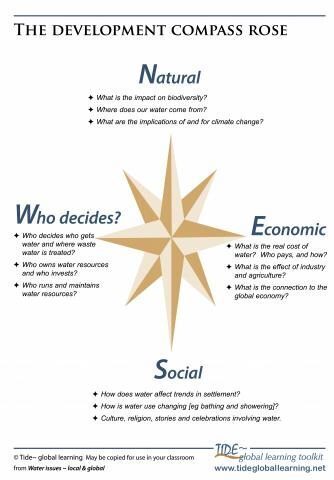
The 'development compass rose' is a framework that can be used to enable students to generate enquiry questions and in doing so to make connections:
~ between the different aspects of an issue or situation by focusing on the natural [environmental], social, economic and considering who decides?
~ between a situation local to us and one local in another part of the world.
Download basic DRC activities
Download blank DRC -original format
The DCR ideas generated by a group of geography teachers working on 'Developing Geography', engaging with the then new National Curriculum, were further developed by groups working towards 'Its our world too! This was at the time of the build up to the Rio Earth Summit in 1992. Many of the issues that are of growing concern now, were on the Rio agenda over 30 years ago.
A consultation pack was published featuring a number of DCR activities and including a set of photos provided by Oxfam, from their 50th anniversary book.


Asking Questions
The ability to form appropriate questions is an important skill. It is built up over time.
It has both individual and group significance.
It is key to engaging with more nuanced debate relating to different views, contradictions, and dilemmas.
The skill of asking questions is fundamental to the processes of democracy.
W - Who decides? The decisions we take individually and those taken by governments, companies and international organisations are all significant. They are key to asking appropriate questions about the potential for change.
Using DCR with photo sets.
A useful discussion can be generated by giving students a set of photos that highlight different issues and asking them to place them around the compass in terms of what they think each represents. Most do not belong in one domain.
As an introduction to using the framework it is useful to use a collection of photographs from different parts of the world. Ask students, working in pairs, to place their photograph in the centre of the compass and generate questions for each of the four 'compass points'. These could then be compared with the questions from other pairs looking at apparently different situations.
If the photos are selected to introduce a theme or issue, it is useful to take this activity further and as a group generate key questions that could be the starting point for enquiry activities.
The DCR has been widely used in the UK and in other countries - most notably, as far as we are aware in Japan, Australia, Ireland and the Basque country.
It can be adapted to use at key stage 2 or for a group of adult leaerners to work on an issue. See for example .......
How do we know - if we don't seek questions to ask? It is an article from ET 2.4 seeking questions about The Commonwealth, in the context of the 2022 Games in Birmingham.
The Sustainable Development Goals [SDGs] are grouped into Social, Environmental and Economic themes. Understanding sustainable development involves making connections between Natural [environmental] systems and Social and Economic activity.
But such understanding is limited unless we also ask the question: Who decides?